
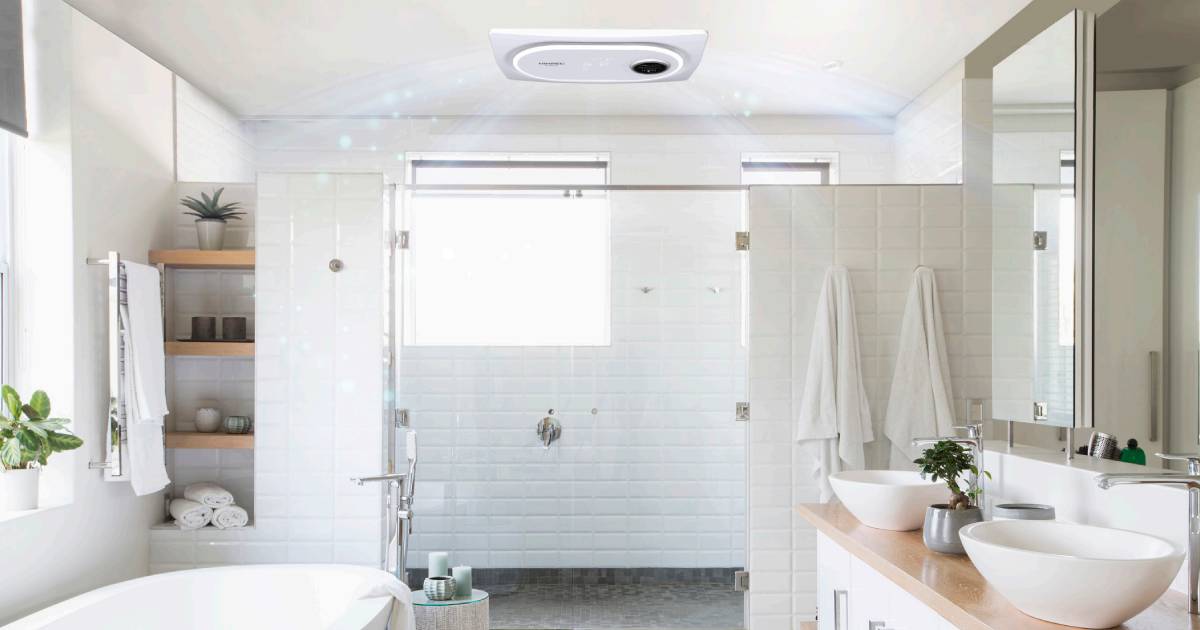
You clean the bathroom properly. A week later there is a faint musty smell again. There is black speckling creeping along the silicone by the shower screen, the bath mat is still damp the next morning, and the grout in the corner has gone a shade darker than the rest.
Most people assume this is a cleaning problem and scrub harder. It is not. It is a drying problem. The Meteorological Service Singapore puts the mean annual relative humidity at around 82%, rising to 100% during long spells of rain. A small enclosed room with a hot shower in it is simply not going to dry itself in that climate. It needs help.
Why the standard exhaust fan struggles here
The fan that came with your flat does one job. It pulls air out for as long as you leave it on. In a cooler country that would be enough, because the air coming in to replace it is dry. In Singapore the replacement air is already sitting at 80 or 90% humidity, so you are swapping damp air for slightly different damp air. It clears the steam and the smell, which is why people assume it is working, but it does much less about the underlying wetness.
Two other things come up constantly in local flats. Nobody leaves the fan on long enough, because two minutes feels like plenty and really is not. And without a proper seal in the duct, odours, cigarette smoke and the occasional insect travel back into your bathroom from elsewhere in the block whenever the fan is off.
It is not just about the smell
Damp is worth taking seriously. When the WHO published its first guidelines on indoor dampness and mould, it found that people living in damp or mouldy buildings had up to 75% greater risk of respiratory symptoms and asthma.
Its advice was straightforward. Control temperature and ventilation so moisture never builds up in the first place, make sure air actually circulates, and do not leave still, stagnant pockets in a room. That is a good description of what a proper bathroom ventilation system is for.
Ventilating, dehumidifying and drying are different jobs
This is the one thing worth understanding before you start shopping, because product names blur it constantly.
- Ventilating pulls air out of the room and sends it outside. It clears steam and smells.
- Dehumidifying actually reduces the moisture in the room. This is what dries down the damp left in grout, silicone and towels once the steam has gone.
- Heating and drying uses warm air to speed all of that up, and in some units to dry your hair and body straight after a shower.
A basic exhaust fan only does the first. A modern ceiling unit does all three, which is why they tend to be called total care ventilators rather than fans.
What to look for
You do not need to compare every specification. Five things cover most of it.
More than one speed. A gentle setting for background use and a strong one for right after a shower do very different jobs.
A quiet, efficient motor. Look for a BLDC motor. It is quieter and uses less power, which matters because a good ventilation system should be running far longer than most people currently run their fan. If it is loud, you will switch it off, and then it does nothing.
A proper sealing damper. This is the part that blocks backdraft, so your neighbour’s cigarette smoke and cooking smells stay in your neighbour’s flat. It is one of the clearest differences between a basic fan and a real system.
Humidity sensing. The unit reads the room and runs until it is genuinely dry, then stops. This solves the human problem completely, because nobody has to remember anything.
Safety and a washable filter. It is an electrical appliance with a heating element in a wet room, so waterproofing and proper safety cut-outs matter. A washable pre-filter also saves you a recurring cost.
The installation part, which catches people out
This is where planning matters more than picking a model. These units sit in the ceiling, so they generally need a false ceiling to house the appliance and a hidden duct running to the nearest window or external opening. Depending on how far that is, a box-up may be needed too.
Condominiums are usually simpler, because most already have a false ceiling and a bathroom window. HDB flats are much easier to do during renovation, since fitting the unit while the ceiling is open is far tidier than returning later to build a false ceiling specifically to hide it and its ducting.
If you are already working with an interior designer or contractor, raise this early so the ceiling height and duct route are decided at the planning stage.
The Himpel range
Himpel is a Korean ventilation specialist and we carry the range here. There are three models.
The HueZentte 3 is the flagship, handling ventilation, dehumidification, heating and hair or body drying in one fitting, with several airflow levels, a quiet BLDC motor, a sealing damper, a washable filter, remote control and mood lighting.
The HueZentte Palette sits in the same family with more attention to finish, for bathrooms where you would rather the ceiling unit blended into the design instead of announcing itself.
The ZEROC combines heating, ventilation, dehumidification and drying with strong, steady airflow, an LED light, a patented electric damper, waterproofing with five safety mechanisms, a washable filter and Bluetooth audio, so you can play music in the shower.
The full range is on our Bathroom collection and Himpel Singapore pages.
A few practical tips
- Position it so it pulls air across the wet area, usually near the shower rather than at the far end of the room.
- Keep the duct run short and as straight as possible. Every bend costs you airflow.
- Leave a gap under the bathroom door so replacement air can get in. A perfectly sealed room cannot be ventilated.
- Check your false ceiling height against the unit depth before you commit.
- If two or three people shower back to back in the morning, size for that, not for an average day.
Conclusion
Bathroom ventilation is one of the few home decisions that is dramatically easier before renovation than after. The unit itself is a short conversation once you know that ventilating, dehumidifying and drying are three separate jobs and that you want a system doing all three, on a sensor, behind a proper damper. The ceiling height and the duct route are the parts that need deciding while the ceiling is still open.
If works are coming up, now is the moment. Come and see the Himpel range at our showroom, 8 Boon Lay Way, Tradehub 21, open daily from 11:00am to 8:00pm. Or send us your bathroom size and renovation timeline and we will take it from there.