
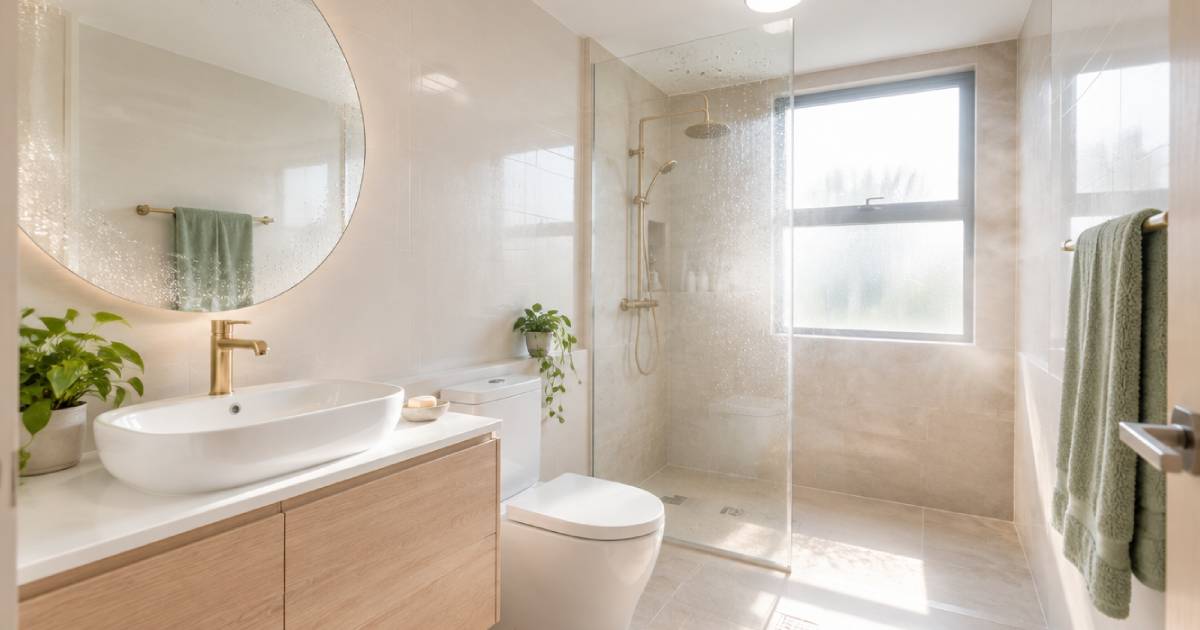
The towel you hung up on Sunday is still faintly damp on Tuesday. The mirror clouds over the moment anyone showers, the grout in the corner has gone a shade darker than the rest, and the little window above the door does not seem to be doing very much at all.
Most Singapore bathrooms behave like this, and it has almost nothing to do with how often you clean them. It has to do with what the air is already carrying before your shower even starts, and with how little chance that air has to move on afterwards.
Why Bathrooms Here Take Longer to Dry
Air can only hold so much moisture, and ours starts the day close to full. The Meteorological Service Singapore puts our mean annual relative humidity at around 82%, rising above 90% in the morning just before sunrise and easing to about 60% in the afternoon.
Drying works by moving moisture from a wet surface into the surrounding air. When that air is already close to saturated, the transfer slows to a crawl, which is why a bathroom in Singapore can still feel tacky hours after the last shower.
Add a bathroom that sits in the middle of the flat with no external window, a household of three or four showering within the same hour, and a small exhaust fan that was specified years ago, and the room simply never gets a chance to reset.
The Wet Stretch Ahead
The calendar is about to make this harder. Singapore moves into its second inter-monsoon period through October and November, and then into the Northeast Monsoon from December to early March, which is the wettest and most persistently humid part of our year. Laundry takes longer, the flat holds onto cooking smells, and bathrooms that coped fine in July start to feel permanently damp. Sorting the bathroom out now means you are not trying to fix it in the middle of a wet fortnight, when every surface in the flat is already working against you.
What a Bathroom Dehumidification System Actually Does
A bathroom dehumidification system pulls damp air out of the room and works it down to a drier state, instead of simply pushing it somewhere else. That is the practical difference between drying a bathroom and merely ventilating it.
Himpel builds ceiling-mounted ducted units that combine both jobs. The Himpel bathroom dehumidifier range covers the HueZentte 3, the HueZentte Palette, and the ZEROC, and the first two handle dehumidification, ventilation, hair and body drying, and warm air from a single ceiling panel. Because the unit is ducted and sits flush in the ceiling, it takes up no wall or floor space, which tends to be the scarcest thing in an HDB bathroom.
Is a Ventilation Fan Enough on Its Own?
Sometimes, and it depends entirely on the bathroom. A window that opens onto a breezy corridor, a household of two, and a fan that still moves properly will keep many bathrooms perfectly comfortable. A windowless bathroom in a busy flat during a wet December is a different proposition entirely, and no amount of leaving the door open will fix it.
The distinction is a useful one to understand before you spend anything, because the two approaches solve slightly different problems:
- A ventilation fan exchanges the damp air in the room for air from outside the room
- A dehumidification function reduces the moisture in the air itself
- A drying function moves air across wet surfaces so they give up moisture faster
- A warm air function raises the temperature of the room, which helps surfaces release moisture
The Himpel HueZentte 3 covers all four, using a PTC heater and a high airtight motorised damper, and it carries IPX3-certified water resistance along with a BLDC fan motor chosen for low noise. The HueZentte Palette offers a similar set of functions with its own high-airtightness damper. The ZEROC keeps things simpler as a ventilation fan with an LED light and a gravity damper, which suits a bathroom that mainly needs better air exchange.
What to Check Before Installation Day
These are ceiling-mounted, ducted units, so the questions are structural before they are anything else. Run through this list with your contractor or with us before committing to a model:
- Whether your bathroom has a false ceiling, and how much space sits above it
- Where the existing duct outlet is, and what diameter it runs at
- Whether the electrical supply at the ceiling can serve the unit
- How the unit will sit relative to the shower area and the dry area
- Whether your bathroom door has an undercut or vent, since air needs a way in
- Who will carry out the installation and coordinate with your renovation works
- Whether any of this needs to happen before your false ceiling goes up
Anyone drawing up a list of everyday comfort essentials for the flat tends to reach these questions early, since ceiling work is far easier to sort out before the carpentry goes in than after.
A Drier Bathroom, Without the Daily Fuss
The goal here is quite modest. A room that dries out on its own between showers, towels that are ready when you need them, and grout that stays the colour it started as. Bathrooms are one of the few parts of a flat where a small improvement gets noticed every single day, twice a day, by everyone in the household.
If you would like to see how the Himpel units sit in a ceiling and hear how quietly they run, head to MyLifestyle Studio Singapore’s showroom. Bring a photo of your bathroom ceiling and the team can tell you what to check next, or send us an enquiry if you would prefer to start there.