
Every HDB kitchen has the same argument going on. The kettle wants a corner, the rice cooker wants a corner, the air fryer has quietly claimed a corner, and the actual chopping happens on whatever strip of laminate is left over.
So when someone suggests adding a water purifier, the first reaction is usually a look at the counter and a polite no. Which is fair. It is also usually based on a mental picture of a machine that is considerably bigger than the ones being sold today, complete with a five-gallon bottle balanced on top.
Small Kitchens, Real Constraints
The constraint in a compact kitchen is almost never the total floor area. It is the length of unbroken worktop between the sink and the hob, because that is where food is actually prepared.
Anything you add to the counter either eats into that strip or it does not. A unit tucked behind the sink, at the far end of the run, or against the return wall usually costs you nothing you were using, while the same unit placed mid-counter costs you the one thing you cannot spare. Position, in other words, does more work than dimensions here. Two kitchens with identical counters can end up feeling completely different depending on where the appliances landed.
Tankless Water Purifier, Explained Simply
A tankless water purifier filters water on demand as it flows through, instead of storing filtered water in an internal reservoir. Removing the tank is the single biggest reason modern units have become so much slimmer than the water dispensers people remember from an office pantry. No reservoir means no standing volume inside the machine, and no standing volume means the casing can be built around the flow path alone.
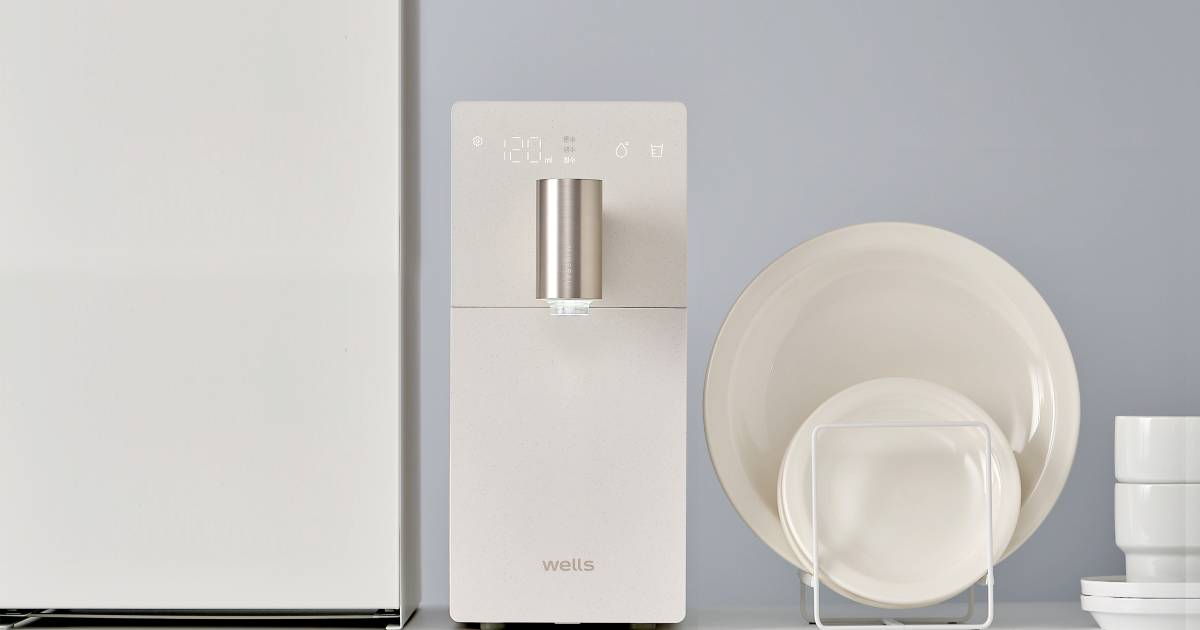
The Wells water dispenser range runs 9-step nanofiltration, with tankless designs and UV sterilisation depending on the model. Wells The One is an ultra-compact counter-top unit at just 8.8 centimetres in diameter, with a 180 degree rotating body, a 4 centimetre full-colour digital display, a motion sensor, and child-lock protection. Wells Slim One sits at 16 centimetres wide and offers 8 temperature options with volume control in 10 millilitre increments, which is handy if you are the sort of person who measures water for coffee.
A water purifier is about convenience and taste preference, about having hot and cold water instantly without boiling or waiting, and about not lugging bottles home from the supermarket.
How Much Counter Space Will You Actually Lose?
Less than you think, and the honest way to find out is to measure before you shop. Take a tape to your kitchen this evening and note down these six things:
- The depth of your counter from wall to front edge
- The length of clear counter you are willing to give up
- The height of your wall cabinets above the counter
- The distance from the nearest power socket
- The distance from the sink and your water supply
- Whether a wall-mounted or under-counter arrangement suits you better
Where the Water Comes From
Direct piping is what makes a compact unit possible. The purifier connects to your existing water supply, so there is no bottle to change and no reservoir sitting inside the machine taking up volume.
That connection does need to be planned, particularly if your kitchen carpentry is already built. The tidiest installations run the line inside the cabinetry, which is straightforward during a renovation and still perfectly doable afterwards with a bit of planning. If your kitchen is already fitted, the installer will look for the shortest discreet route from the supply point, so it helps to know what sits behind and beneath your sink cabinet before the visit.
The Wells Mini water purifier is the interesting option for the tightest kitchens, since it requires no electricity at all and offers three faucet positions, which gives you more freedom about where it ends up sitting.
Making Room Without Losing the Kettle Corner
A water purifier often replaces more than it adds. The kettle, the flask, the case of bottled water under the sink, and the jug in the fridge door tend to become optional once hot and cold water are available at the press of a button.
Families who have been trying to start with better hydration usually find the counter argument settles itself, because a glass of water stops being a small chore. Children reach for water more readily when it is at hand and already cold, which quietly solves a problem most parents have given up nagging about.
If space is genuinely at its limit, four small moves usually free up what you need:
- Hang utensils and ladles on a wall rail instead of a counter caddy
- Retire the water jug that lives in the fridge door
- Shift the rice cooker to a pull-out shelf if your carpentry allows
- Use the return wall or the end of the counter run, which is often dead space
Seeing It in Person Helps
Dimensions on a page are difficult to picture. Standing next to a water dispenser unit and putting your hand where your chopping board would go settles the question in about thirty seconds.
Our showroom at 8 Boon Lay Way has the full Wells water dispenser range set up on real counters, and it is open daily from 11am to 8pm. Bring the measurements from your kitchen and the team can tell you which models fit comfortably, or send us an enquiry if you would rather narrow it down before making the trip.