
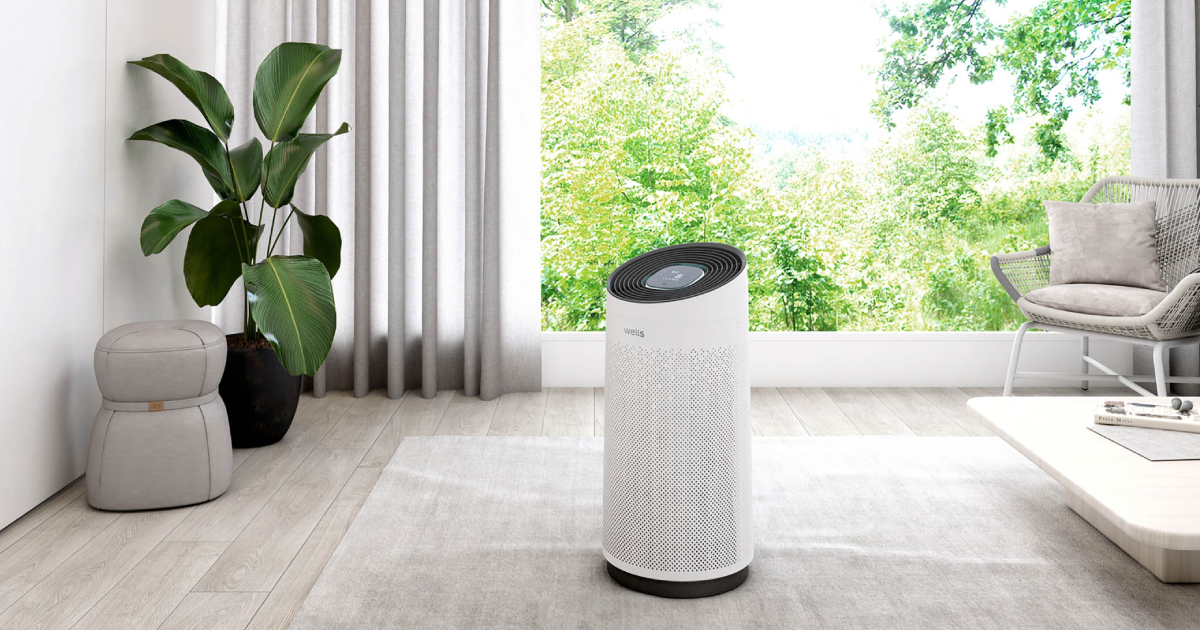
If you have lived here for a while, you probably think about air quality twice a year at most. Once when the sky turns hazy and everyone starts checking readings on their phone, and once when a neighbour begins renovating, the whole corridor smells of paint. The rest of the time the air looks clear, the skyline is sharp, and there is nothing obvious to act on.
Yet air purifiers have quietly become standard equipment in Singapore homes, sitting in bedrooms and living rooms alongside the fan and the dehumidifier. Not because the air outside has deteriorated, but because two things have shifted underneath the question.
The good news first
Singapore’s outdoor air really has improved. The National Environment Agency publishes the annual average for PM2.5, the fine dust that matters most for health, and the figures are public on data.gov.sg.
In 2015, the haze year, the annual average reached 24 micrograms per cubic metre. Every year since 2020 it has sat at 11 or 12. That is a genuine halving, and the national target Singapore set itself has been met. So far, so straightforward. The complication is what happened to the benchmark.
The goalposts moved
In 2021 the World Health Organization reviewed fifteen years of new research and cut its recommended annual limit for PM2.5 in half, down to 5 micrograms per cubic metre. The evidence showed health effects at concentrations earlier studies simply could not detect.
Singapore sits at 11 to 12, which is still more than double what the WHO now considers ideal. This is not a Singapore problem: almost no country in the world meets that guideline. It does mean, though, that air which counts as clean by national standards and air which is easy on your lungs are now two different things.
The bigger issue is usually indoors
Here is the part most people miss. Whatever is happening outside, the air you actually spend the day breathing is the air inside a fairly small, fairly sealed, air-conditioned home.
The WHO has noted that where there are indoor sources of dust and particles, indoor levels are usually higher than outdoor levels. A Singapore home has no shortage of sources:
- Wok cooking and frying, which release a surprising quantity of fine particles and oil vapour
- Dust mites, which thrive in year-round humidity and settle into mattresses, sofas and curtains
- Pet hair and dander
- The new-furniture smell in a freshly renovated flat, which is real chemistry releasing slowly into the room
- Renovation dust drifting in from the unit two floors up
- Cigarette smoke and cooking smells travelling in from the corridor or the neighbouring kitchen
None of that appears in a national average. All of it appears in your bedroom. And air conditioning does not solve it, because an aircon unit cools and recirculates the same air. The mesh filter inside is there to stop lint clogging the coil, not to capture fine dust.
The haze has been quiet, not absent
Haze depends on regional weather and dry conditions, and it has been mild for several years. That is not the same as gone. The NEA continues to track and publish readings on its air quality page for exactly that reason.
The frustrating thing about a haze episode is that shutting the windows only takes you so far. Fine particles enter through gaps and door undercuts, and a room with no filtration drifts slowly towards whatever is happening outside. A purifier already running keeps that curve much flatter, which is an argument for buying before a spike rather than during one.
What to actually look for
You do not need to become an expert in filtration to choose the right purifier. Four things cover most of it.
A real HEPA filter. Watch for wording such as HEPA-type or HEPA-like, which is not the same thing. A H14 grade filter, the class used in hospitals, captures 99.997% of fine dust, and that is the grade used across most of the Wells range we carry.
The right size for the room, not the flat. Coverage figures assume one enclosed space, and air does not travel well around corners or through doorways.
Sensors that do the thinking. A purifier that measures the air and adjusts itself will sit quietly on low for most of the day and speed up only when it needs to. That means less noise, less electricity and nothing to remember.
Quiet enough for the bedroom. If you switch it off at night because it is irritating you, it is not working. Around 28dB is soft enough to sleep through.
Matching one to your home
Most households do better with the right unit in the two rooms they actually use than with one large unit trying to cover everything.
- Bedroom, study or nursery. The Wells Interior is built for this. Compact, with a quiet study mode, and it can be wall-mounted if floor space is already spoken for.
- Living room or a shared floor. The Wells Jet Blue covers up to 51.9 square metres in a slim tower shape designed to sit against a wall rather than block a walkway.
- Large open-plan living and dining. The Wells Tornado draws air in from all sides rather than one face, which matters in a big room where a single-direction purifier leaves dead corners behind it.
All three sit side by side on the Living collection page, and if you are refreshing more of the home at once, our earlier piece on everyday comfort essentials covers the same ground from a different angle.
Conclusion
The case for an air purifier in Singapore was never really about haze. It is that the national average, though much improved, still sits above the WHO’s guideline level, and that the air in your own flat is shaped far more by your kitchen, your pets and your renovation than by anything measured at a roadside station. Indoor filtration is one of the few parts that a household can actually control.
Coverage figures will narrow the choice to two models. How loud something is, and how it looks in your living room, are things you have to judge standing next to it. Our showroom is at 8 Boon Lay Way, Tradehub 21, open daily from 11:00am to 8:00pm, or you can send us your room sizes and we will point you at the right one to look at first.